
PFAS Restrictions and Foodservice Packaging: What Buyers Should Review
Per- and polyfluoroalkyl substances (PFAS) have moved from a niche chemistry topic to a front-line procurement issue for anyone buying foodservice packaging. Regulators in Europe and the United States are tightening the rules on intentionally added PFAS in food-contact materials, and the pace of change varies widely by market. For foodservice buyers, brand owners, and distributors, the practical question is no longer "will PFAS be restricted?" but "what do I need to review before I place my next order?" This guide outlines where the major rules stand today, why they differ by jurisdiction, and the specific documents and specifications buyers should request. Rules and proposals are evolving, so treat the summaries below as a starting point and confirm the current position with the relevant authority before you make sourcing decisions.
Why PFAS Is Under Scrutiny in Foodservice
PFAS are a large family of synthetic chemicals valued for their grease, oil, and water resistance. In foodservice packaging, they have historically been used as grease-proofing agents in molded fiber bowls, paperboard clamshells, wraps, popcorn bags, and pastry liners. The same persistence that made them useful also makes them a regulatory target: PFAS resist environmental breakdown, can migrate into food, and are associated with human-health concerns. Because they are difficult to destroy and accumulate over time, agencies increasingly focus on restricting the whole class rather than chasing individual compounds one at a time.
The Regulatory Picture Differs by Jurisdiction
There is no single global PFAS rule. Requirements depend on where the packaging is placed on the market, and in the United States they can differ from one state to the next. The summaries below reflect widely reported regulatory activity, but details, scope, and effective dates change. Verify each requirement against the primary source for your target market before relying on it.
European Union (ECHA)
In 2023, authorities from Denmark, Germany, the Netherlands, Norway, and Sweden submitted a broad "universal" PFAS restriction proposal to the European Chemicals Agency (ECHA) under the REACH regulation. ECHA's scientific committees for Risk Assessment (RAC) and Socio-Economic Analysis (SEAC) are evaluating the proposal on a sector-by-sector basis, including food-contact applications. This is a proposal, not a finalized law: its final scope, any derogations, and transition periods are still being worked through and could change before—or if—it is adopted. Separately, some EU member states have already acted at national level on PFAS in paper and board food-contact materials, so buyers selling into Europe should check both EU-level and national requirements.
United States (FDA)
At the federal level, the U.S. Food and Drug Administration (FDA) regulates substances used in food-contact materials. Following agreements with manufacturers, the FDA announced that grease-proofing agents containing certain PFAS are no longer being sold for food-contact use in the U.S. market—a voluntary market phase-out intended to eliminate a key source of dietary PFAS exposure from items such as wrappers, take-out containers, and microwave popcorn bags. This addresses specific authorized uses; it does not replace the growing patchwork of state laws, which are frequently broader.
US State Laws
A number of U.S. states have enacted their own restrictions on intentionally added PFAS in food packaging, often defined by a total-fluorine or total-organic-fluorine threshold. States including California, Washington, New York, Maine, Minnesota, Colorado, Connecticut, and others have adopted such measures, with effective dates spread across recent years and reporting or disclosure duties in some cases. Definitions, thresholds, exemptions, and enforcement timelines are not uniform. If you distribute nationally, you should map requirements state by state rather than assuming a single national standard applies.
Aluminum Is Not an Automatic Exemption
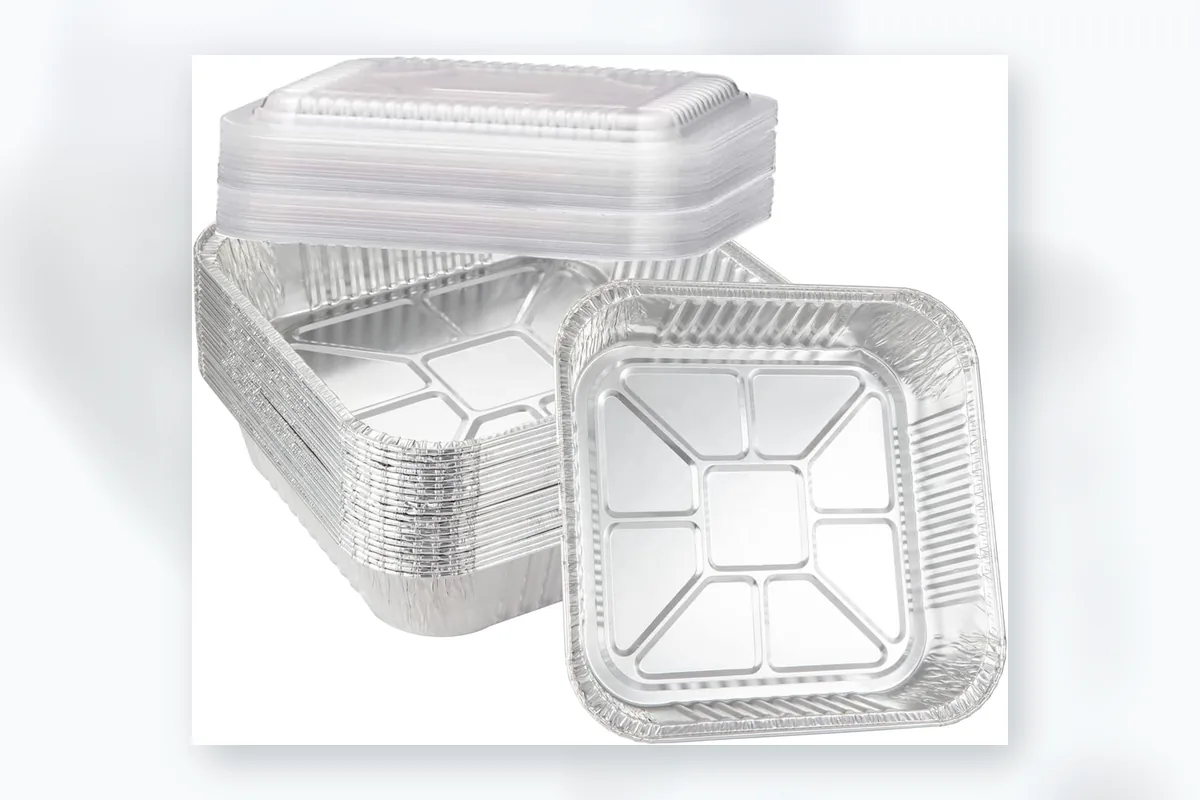
Aluminum foil containers are a popular alternative because the container body is metal rather than PFAS-treated fiber. That is a genuine advantage, but it does not, on its own, guarantee PFAS compliance for the finished pack. A foodservice pack is a system, and PFAS or other regulated substances can be present in components beyond the aluminum itself. Buyers should look at the whole assembly rather than the base metal alone.
Key areas to examine include the lidding, any internal lacquer or coating applied to the foil, heat-seal films and laminates, printing inks, and adhesives. A board or fiber lid, a laminated film lid, or a coated surface could introduce substances that a plain aluminum tray would not. The correct conclusion is not "aluminum solves everything," but "aluminum removes one common source of PFAS while the remaining components still need documentation." Ask your supplier to confirm the status of every material that touches food or forms part of the pack.
A Buyer's Review Checklist
Use the table below as a structured starting point when qualifying a foodservice packaging supplier or a specific SKU. Adapt it to the jurisdictions you sell into.
| Review Area | What to Request | Why It Matters |
|---|---|---|
| Base container | Material specification and food-contact declaration for the aluminum | Confirms the tray body meets food-contact requirements for your market |
| Lids and films | Composition and PFAS status of board, plastic, or laminate lids and heat-seal films | Lids are a frequent source of regulated substances, not the metal tray |
| Coatings and lacquers | Details of any internal coating, lacquer, or release layer | Coatings can carry intentionally added substances that trigger state limits |
| Inks and adhesives | Declarations for printing inks and laminating adhesives | Non-food-contact layers may still fall within packaging rules |
| Jurisdiction mapping | List of target markets (EU, US federal, specific US states) | Requirements and thresholds differ, so scope drives the evidence needed |
| Documentation | Statements of compliance, test reports, and relevant certificates | Written evidence supports audits and customer due-diligence requests |
Practical Steps for Procurement Teams
- Define the exact markets a SKU will ship to before you ask for evidence, since the applicable rules follow the destination.
- Request written declarations covering intentionally added PFAS for every food-contact component, not just the tray.
- Ask whether declarations are based on formulation data, supplier attestations, or laboratory testing, and keep copies on file.
- Review our foil containers with lids as complete systems, checking the lid material alongside the tray.
- Explore the full aluminum foil packaging range and discuss tailored formats through our packaging solutions team.
- Verify current documentation on our certificates page and confirm any market-specific questions with the relevant authority.
- Re-check requirements periodically, because proposals such as the EU restriction and several state laws are still evolving.
Authoritative references
Frequently Asked Questions
Are PFAS already banned in all foodservice packaging?
No. There is no single global ban. The EU is still evaluating a broad PFAS restriction proposal that is not finalized, the FDA has secured a voluntary phase-out of certain grease-proofing PFAS in the U.S. market, and individual U.S. states have their own laws with differing scopes and dates. Always confirm the current rule for your specific market.
Do aluminum foil containers automatically meet PFAS rules?
Not automatically. The aluminum body avoids one common source of PFAS found in treated fiber packaging, but lids, internal coatings, heat-seal films, inks, and adhesives still need to be reviewed. Treat the pack as a complete system and request documentation for every food-contact component.
What documents should I keep on file for audits?
Retain material specifications, statements of compliance or declarations for each component, any laboratory test reports, and current certificates. Pair these with a jurisdiction map showing where each SKU is sold so you can demonstrate that the right requirements were applied. Contact our team through the contact page if you need supporting documentation for a specific order.
Looking for aluminum foil containers?
We supply food-grade aluminum foil containers for airlines, restaurants and food processors worldwide. Get a free quote today.
Get Free Quote → Browse Products