
What Aluminum Alloy Is Best for Food Foil Containers?
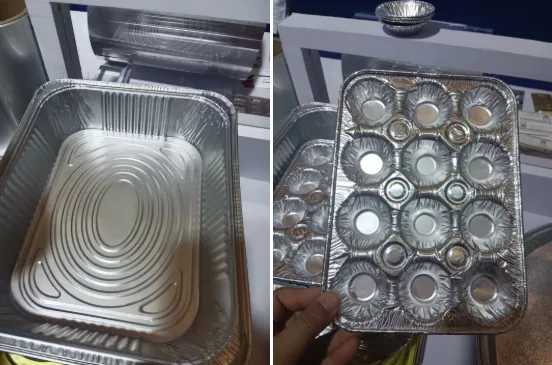
What aluminum alloy is best for food foil containers?
When sourcing food-grade aluminum foil containers, the alloy choice directly impacts performance, cost, and safety. In our factory, we predominantly use alloys 8011 and 3003 for food trays, baking cups, and lids. Both are FDA-approved under 21 CFR 176.170 for direct food contact. But which one is 'best'? It depends on your product's specific requirements.
Alloy 8011 is the industry workhorse for thin-gauge containers (0.03–0.08mm). It offers excellent formability, puncture resistance, and a smooth surface for printing. For example, our standard round trays for deli takeout use 8011-O (fully annealed), which ensures tight lid sealing without cracking. Alloy 3003, with added manganese, provides higher strength and stiffness. It's ideal for larger rectangular trays that need to hold heavier loads, like airline meal containers. We use 3003-H24 for these—temper gives rigidity while retaining enough ductility for deep drawing.
So, no single 'best' alloy exists. Choose 8011 for cost-sensitive, high-volume items like baking cups (where flexibility matters), and 3003 for structural integrity in large trays. Both meet FDA and EU standards, and we can mix alloys in one order if needed.
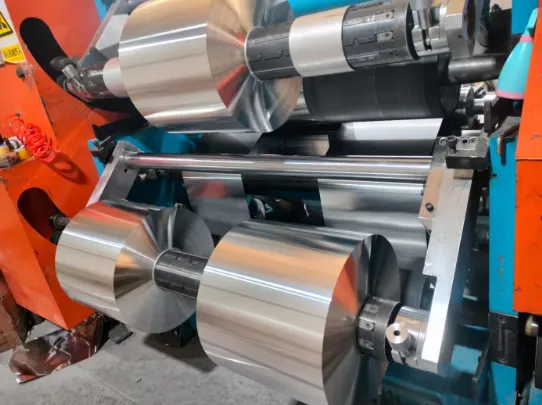
What are the key differences between alloy 8011 and 3003?
Let's break down the specs. Alloy 8011 contains mainly aluminum plus iron and silicon (Al-Fe-Si series). It's softer, more ductile, and cheaper to produce. Alloy 3003 adds about 1–1.5% manganese, boosting tensile strength by roughly 30% compared to 8011. For a 0.05mm thick sheet, 8011 offers tensile strength of 80–110 MPa, while 3003 reaches 110–150 MPa. That extra strength matters when you're stacking heavy portions or freezing containers.
Another difference: corrosion resistance. 3003 performs better in acidic foods (tomato sauce, citrus) because manganese stabilizes the alloy. 8011 is still safe but may show slight pitting over long contact with high-acid items. For short-term use (under 24 hours), both are fine. We test both alloys with pH 3–9 foods per FDA migration limits, and results show no safety issues.
Cost-wise, 8011 is about 5–10% cheaper per ton than 3003. For a 500ml rectangular tray, the material cost difference is roughly $0.001–0.002 per piece. At 1 million pieces, that's $1,000–2,000 savings—significant for high-volume buyers. However, if you need thicker foil (above 0.08mm) for heavy-duty use, 3003 becomes more economical because you can use a slightly thinner gauge and still get the same stiffness.
| Property | Alloy 8011 | Alloy 3003 |
|---|---|---|
| Tensile Strength (MPa) | 80–110 | 110–150 |
| Elongation (%) | 20–30 | 15–25 |
| Typical Gauge (mm) | 0.03–0.08 | 0.05–0.15 |
| Formability | Excellent | Good |
| Corrosion Resistance | Good | Better |
| Relative Cost | Lower | Higher by 5–10% |
| Common Uses | Baking cups, small trays, lids | Large trays, airline containers |
What about alloy 1100 or 1235 for food containers?
You might have heard of alloy 1100 (commercially pure aluminum, 99% min) or 1235 (99.35% min). They're used in household foil rolls but rarely for rigid containers. Why? Pure aluminum is too soft. When deep-drawn into a tray shape, it tends to wrinkle or tear at corners. Our factory tested 1100 for a custom baking cup order—the failure rate was 12% vs.<2% with 8011. That's unacceptable for mass production.
However, 1235 is excellent for thin foil wraps (0.006–0.02mm) used in candy packaging or butter wraps. For containers, stick with 8011 or 3003. Some suppliers claim 'pure aluminum' containers are safer—that's a misconception. The added elements in 8011/3003 are within FDA limits and actually improve food safety by preventing leaching. We've held GMP and HACCP certifications since 2009, and our alloy selection undergoes annual third-party audits.
How do I choose the right temper for my foil containers?
Temper matters as much as alloy. The most common tempers are O (annealed, soft) and H24 (strain-hardened and partially annealed). For containers, O temper is standard for deep-drawn products because it flows into molds without cracking. H24 is used when the container needs extra rigidity after forming—like a lid that snaps onto a tray.
We recently produced 500,000 rectangular airline meal containers in 3003-H24 for a client. The temper allowed a thinner gauge (0.06mm vs. typical 0.08mm), saving 25% on material weight. The containers passed drop tests from 1.5m without denting. For baking cups, 8011-O is best—customers want a soft cup that doesn't tear when folding edges. Always specify temper in your RFQ; we can adjust within our 12 production lines.
What certifications should I look for in aluminum foil alloys?
For food contact, the minimum is FDA 21 CFR 176.170 (US) and EU Regulation 1935/2004. Our alloys meet both, plus China GB 4806.9-2016. But don't stop there. Look for ISO 9001 (quality management), ISO 14001 (environmental), and ISO 50001 (energy). We hold all three, which ensures consistent alloy composition batch-to-batch. Also, HACCP certification means the factory controls hazards from raw material to shipping.
A common mistake: assuming all 'food-grade' foil is identical. We've seen competitors use recycled scrap with unknown alloy mixes. That can introduce lead or cadmium. Our raw material comes from certified mills (e.g., Chalco, Norsk Hydro) with full traceability. We test each coil for heavy metals per EPA 3050B. Ask your supplier for a Certificate of Analysis (COA) per batch—we provide it free.
Can I use the same alloy for both container and lid?
Often, yes, but not always. For a standard round container with a peel-off foil lid, both can be 8011-O. The lid needs to be thin (0.03–0.05mm) and easy to tear. However, if you want a rigid plastic lid (PET or PP), the foil container alloy doesn't matter as much. For heat-sealable lidding foil, we use 8011 with a heat-seal coating on one side—the base alloy remains 8011.
One exception: if the lid needs to be embossed or printed with high detail, 3003-H24 gives a crisper image because it's harder. We did a run of custom-printed lids for a premium bakery brand using 3003-H24 at 0.04mm—the registration was within 0.2mm. For standard applications, save cost with 8011.
What is the minimum thickness for a food container?
For round containers under 500ml, 0.04mm is the thinnest we recommend for reliable performance. Below that, the container may buckle under weight. For large rectangular trays (e.g., 200x300mm), start at 0.06mm. Our standard MOQ is 50,000 pieces, and we offer free samples for qualified buyers so you can test thickness before committing.
Does the alloy affect recyclability?
Both 8011 and 3003 are 100% recyclable. Aluminum retains its properties infinitely. In fact, over 75% of all aluminum ever produced is still in use. Using recycled content (post-industrial scrap) can reduce carbon footprint by 95% vs. primary aluminum. Our factory recycles all production scrap internally—about 8% of our input is recycled back into new coils.
How do I specify alloy in my purchase order?
Write: "Alloy 8011-O per ASTM B209, temper O, gauge 0.05mm ±0.005mm, width 300mm, food-grade coated per FDA 21 CFR 176.170." For 3003: "Alloy 3003-H24 per ASTM B209, temper H24." Include any custom dimensions or printing requirements. We'll confirm within 24 hours with a technical drawing.
Looking for aluminum foil containers?
We supply food-grade aluminum foil containers for airlines, restaurants and food processors worldwide. Get a free quote today.
Get Free Quote → Browse Products